Invited state-of-the-art review
New treatments for treatment-resistant depression: esketamine controversies – a narrative review
4. aug. 2026
16 min.

This narrative review examines barriers to Danish patients’ timely access to new treatments for treatment-resistant depression, focusing on controversies around esketamine. Delays arise from regulatory complexity, economic constraints and scientific debate over novel psychotropics. The review advocates evidence-based, faster implementation pathways for new treatments to alleviate the overall individual and societal burden from severe depression in Denmark.
Esketamine is among the evidencebased options for treatmentresistant depression.
Early concerns about safety, potential for abuse, high cost and regulatory issues delayed Danish uptake.
Long-term data so far indicate limited real-world misuse when used under controlled conditions.
The next step is to provide a standardised infrastructure to integrate esketamine treatment into routine clinical practice and to monitor its use and risk of misuse.
About 25-30% of patients with major depressive disorders (MDD) do not recover completely despite treatment. Treatmentresistant depression (TRD), commonly defined as nonresponse to ≥ 2 adequate antidepressant trials, is associated with substantial disability, morbidity, suicidality and healthcare costs [1, 2]. At a national Danish level, patients with MDD show persistent functional impairment despite existing treatment, as reflected in the latest report on “The burden of disease in Denmark” [3]. This report,from 2022states that MDD accounts for 35.9% of those being granted early withdrawal from the labour market in Denmark. Hence, Danish patients with depression show persistent functional impairment despite existing treatments, as shown in a Danish register study revealing that patients have higher levels of sickness absence and lower levels of reintegration into the labour market after meeting the criteria for TRD [4].
Ketamine’s psychiatric history reflects six decades of shifting scientific and clinical use [5]. Originally synthesised in the early 1960s, ketamine was introduced into both human and veterinary medicine as a dissociative anaesthetic notable for its rapid onset of action and minimal cardiovascular side effects [6]. Within the field of psychiatry, ketamine gained prominence in experimental psychopathology as a tool for modelling psychosis through antagonism of the N-methyl-D-aspartate (NMDA) receptor. By the early 2000s, clinical investigations revealed that ketamine produced rapid and robust antidepressant effects, thereby catalysing the emergence of novel glutamatergic and neuroplasticity-oriented models of depression [6]. Reconceptualisation of ketamine as a rapid-acting antidepressant [7, 8] prompted a shift in psychiatric thinking, challenging assumptions about the delayed onset of antidepressant efficacy. Ketamine’s therapeutic effects seem to be mediated by rapid modulation of the NMDA receptor and enhancement of glutamate signalling, in contrast to conventional antidepressants, which primarily target serotonergic or noradrenergic pathways [9].
Building on these results, intranasal esketamine was developed, tested [10-12] and approved by the U.S. Food and Drug Administration in 2019 [13] for use in TRD in combination with an antidepressant [14]. Esketamine nasal spray (Spravato) was further approved by the European Medicines Agency (EMA) in December 2019. The indication was moderate to severe TRD in combination with a selective serotonin reuptake inhibitor (SSRI) or serotonin–noradrenaline reuptake inhibitor (SNRI). The approval is valid in all 27 EU member states, EEA countries (Norway, Iceland and Liechtenstein) and Northern Ireland. Administration must occur under the supervision of a healthcare professional, with a post-administration observation period. In 2021, the approval was expanded to include adults with MDD experiencing a psychiatric emergency, specifically for the rapid reduction of depressive symptoms in those with acute suicidal ideation [15].
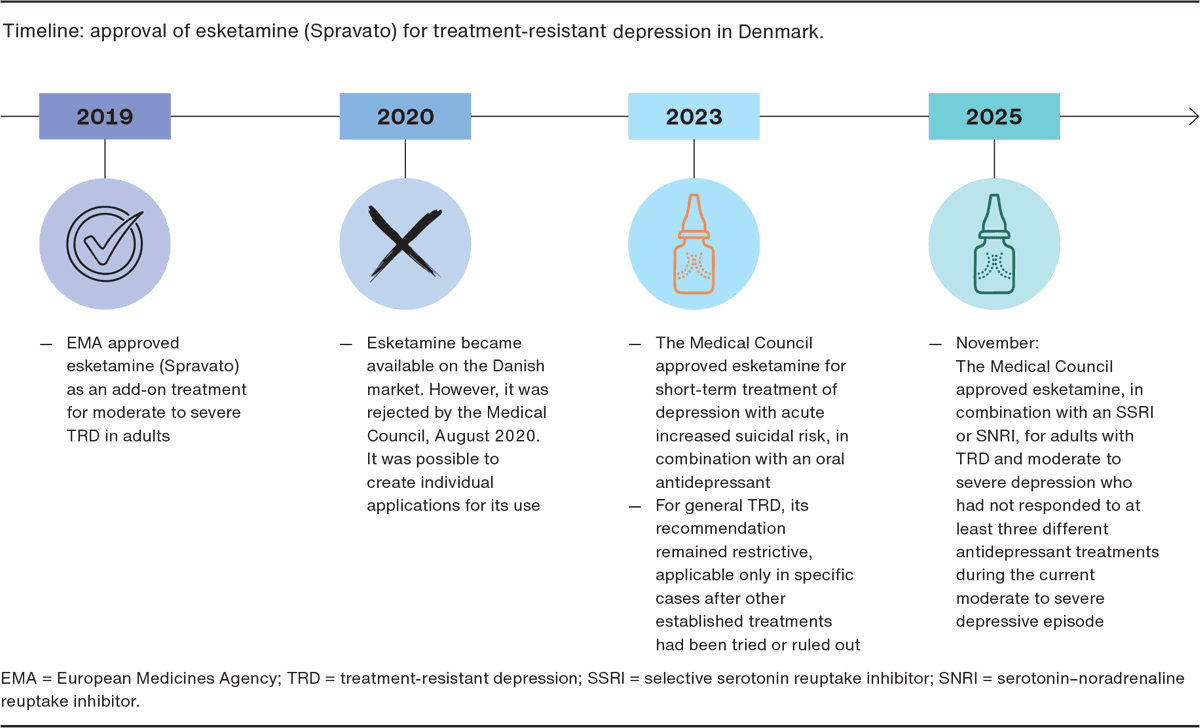
In 2020, esketamine was the first newly developed antidepressant drug in several years to potentially reach Denmark (see timeline in Figure 1). Clinicians hoped that it would be an important advance in treating depression. However, after its introduction, there was surprisingly little enthusiasm for adoption. In 2020, the Danish Medical Council declined routine use for TRD, requiring case-by-case application where the doctor and patients should document that all other approved treatments for depression had been tried. The Council noted that only data on four weeks of treatment efficacy were available at that time, leading to considerable uncertainty about long-term effects and side effects. Additionally, the Council criticised the TRD population definition used in industry-funded studies and questioned its applicability to the Danish TRD population. Concerns were also raised about its high cost. This decision was upheld after a reapplication in 2022-2023. However, in 2023, esketamine was approved for short-term treatment of depression with acute increased suicidal risk, to be used in combination with an oral antidepressant.
In November 2025, after providing long-term evidence of efficacy, reduced cost and better observation of potential long-term harms (32 weeks), the Danish Medical Council approved esketamine for use in patients with TRD. Treatment should be initiated and discontinued in accordance with the criteria available on the Council's website. Esketamine is recommended for treatment of adults with TRD who have failed at ≥ 3 antidepressant treatments within the current episode [16] (local, Danish criterion, more restrictive than the international TRD definition (≥ 2 failed adequate antidepressant trials). It is recommended as an alternative to electro convulsive therapy ECT, especially for patients who cannot tolerate, do not benefit from or do not want ECT. Regarding treatment procedures and safety, treatment should take place in a psychiatric ward, as patient observation is required for each treatment (e.g., due to high blood pressure and dissociative symptoms). Treatment starts with an induction phase (typically four weeks), after which the effect (remission/response) is evaluated before continuation (Figure 2).
A 2025 PRISMA meta-analysis of 87 studies found a weak but statistically significant antidepressant effect of esketamine at weeks 2-4 (effect size 0.15-0.23), although most included randomised controlled trials (RCTs) were mostly negative or failed, with no significant effect on suicidality, consistent with the sensitivity analyses [17]. Using other inclusion criteria, another meta-analysis of RCTs graded the certainty of evidence as "moderate" or "high" [18] for treatment with esketamine nasal spray in conjunction with an antidepressant to control short-term and long-term depressive symptoms in MDD and TRD. Another 2026 meta-analysis analysed the therapeutic and preventive effects of esketamine in MDD or TRD, postpartum depression (PPD) and perioperative depression [19]. This meta-analysis included 67 trials (11,553 participants) that reported short and long-term efficacy for MDD/TRD and prevention of PPD and postoperative depression. Furthermore, a systematic review and network meta-analysis compared different antidepressant treatments for TRD. The analyses included 10,285 TRD patients (25 different treatments), with only ECT, minocycline, theta burst stimulation, repetitive transcranial magnetic stimulation (rTMS), ketamine and aripiprazole being clearly superior to placebo [20].
Intranasal esketamine has demonstrated rapid antidepressant effects in RCTs. However, the effect sizes are modest, results across studies show considerable heterogeneity and unblinding can be difficult due to the characteristic side effect of dissociation. In the context of TRD, small effect sizes are expected due to the inherent treatment challenges in this population. Real-world evidence consistently indicates that intranasal esketamine is associated with clinically meaningful symptom reductions and increasing remission rates over time in routine clinical settings [21]. Given that these observational studies lack control groups, effect sizes should be interpreted with caution. Nonetheless, these findings offer valuable insights into esketamine’s effectiveness and tolerability in everyday practice and highlight the need for controlled comparative studies to guide long-term treatment strategies.
Esketamine’s acute adverse effects include transient dissociation, elevated blood pressure, nausea and dizziness [15]. A 2026 systematic review based on treatment protocols and clinical outcomes found that most events were mild to moderate and declined during maintenance therapy. Treatment discontinuation due to adverse events was low (7.2%, 95% CI: 5.1-9.3%) [22]. Furthermore, esketamine may increase lower urinary tract symptoms, such as dysuria or urgency. However, severe bladder pathology has not been reported among patients receiving doses of esketamine [23]. Finally, there have been reports of impaired cognition; however, a recent review concluded that esketamine does not appear to be associated with cognitive deterioration [24].
A recent meta-analysis emphasised that modest efficacy must be interpreted with caution, considering esketamine’s abuse potential and the limited long-term evidence for its effect [25]. Even six years after approval, leading experts emphasise unresolved “clinical conundrums and unanswered questions” regarding esketamine use [26]. However, emerging safety data show that earlier fears of misuse have not materialised under current riskmanagement frameworks. Long-term clinical studies have not documented abuse, misuse, addiction or withdrawal [27]. A 2025 safety review found no evidence of these issues in clinical trials, high-risk samples or real-world cohorts, including populations with substance or alcohol use disorders [28]; in contrast to a pharmacovigilance study from 2024 that revealed a relative risk ratio for drug use disorder of 6.6 [29]. These findings align with a 2023 systematic review on the quality of adverse events reported in published clinical trials of esketamine, which was judged as poor, while harms were reported less frequently in journal publications than in ClinicalTrial.gov registers [30]. Overall, the results underpin the need for esketamine to be administered in-office, under supervision, with brief post-dose observation.
Despite clinical evidence suggesting that esketamine offers a superior, rapid-acting alternative for patients with TRD, its high cost impedes its clinical implementation. This cost burden has triggered debate over its cost-effectiveness. A 2020 study found esketamine to be a low-value option compared with traditional treatments [31], and the authors concluded that the price should be reduced by more than 40%. Another study compared the cost of ECT and esketamine treatment and concluded that, from a cost-effectiveness perspective, ECT should be the first option for individuals with TRD when other first-line treatments have failed [32]. However, an overall review of 31 reports describing the methods used in the economic evaluation of interventions for the management of TRD concluded that economic evidence for these interventions was underdeveloped. It was emphasised that existing evidence was hampered by inconsistent study design, methodological quality and availability. Finally, efforts to generate more robust health-state utility data specific to TRD and to establish consensus on a core outcome set that incorporates these measures were recommended [33].
In 2020, the lack of longitudinal data and real-world evidence led to some conservatism in the implementation of esketamine. However, the ESCAPE-TRD study on the long-term use (32 weeks) from 2023 added new data and found that the long-term relapse rate was significantly lower in the intranasal esketamine group than in the placebo/quetiapine extended-release group [34]. The rate of suicidal ideation was similar between the two groups [34]. In further sensitivity analyses, esketamine consistently demonstrated significant superiority over quetiapine across all prespecified definitions of remission and relapse, demonstrating that esketamine provides rapid antidepressant effects [35]. Long-term durability is not fully established. However, the recently published ESCAPELTE extension study followed participants up to 136 weeks [36]. This study found that esketamine nasal spray with SSRI/SNRI seems to sustain or deepen antidepressant effects, with low relapse rates, high retention and a stable safety profile, resulting in sustained improvements in symptoms, global severity and quality of life. Although ESCAPE-LTE is open-label and lacks a comparator, it provides valuable data on durability, dosing flexibility and long-term safety, which are essential for real-world implementation. The recommendations should include predefined criteria for continuation or discontinuation, structured tapering, rapid re-induction if relapse occurs and the collection of broader outcome measures, e.g., functioning and healthcare utilisation. So, despite some maintenance benefit [34, 36], generalisability and outcome (functioning, cognition, suicide, admissions, the risk of illicit misuse) require further data to characterise the trajectories and length of long-term treatments [25].
Esketamine was developed to address unmet needs in TRD. Despite EMA approval, its accessibility has been limited in several countries due to regional policy and reimbursement challenges. However, Danish patients accessed it later than those in comparable European countries. Denmark’s slow uptake (fewer than twenty treated patients early on) reflects restrictive initial criteria, application burdens and infrastructure needs (staffing, in-clinic observation). This may have resulted in a highly selected patient group, limiting the generalisability of the study. So, the impact in Denmark has yet to be established. Additionally, Denmark's delayed adoption meant missing opportunities to gain clinical experience in other European countries, such as developing treatment algorithms, as done, e.g., in Spain [35].
Recognising these challenges, the Danish Multidisciplinary Psychiatry Groups (DMPG) has initiated an update of the existing guidelines [37], and a new treatment algorithm for depression is in the pipeline for 2026. The next steps include establishing an infrastructure with efficient referral pathways and ensuring that treatment centres have appropriate expertise, staffing and training. The Danish Medical Council urges the DMPG to collect data on esketamine use to monitor consumption, efficacy and side effects. Systematic monitoring will be valuable to track individual clinical outcomes to characterise the typical trajectories (response; relapse, long-term treatment, overall functioning, misuse) and societal effects (costs, admissions). So, in the current landscape, esketamine is an option within a multimodal TRD algorithm. Compared with ECT, it is less invasive but may be less robust for severe psychotic depression; rTMS is non-invasive but requires many sessions. Monoamine oxidase inhibitors, lithium, aripiprazole and quetiapine remain important pharmacologic options, equivalent to intranasal esketamine as augmentation. The choice should be individualised, guided by prior treatment history, risk of suicide, comorbidity, access and patient preference [1, 38, 39]. Please see Figure 2 for an illustration.
Modern treatment of depression is becoming increasingly complex and involves a thorough assessment and combined treatments, and personalised management of depression in adults requires a targeted and systematic approach to clinical characterisation [40]. Despite considerable ongoing debate on esketamine [41] and many differing opinions about depression and its treatment, widespread reservations may have delayed the development of modern treatments reaching patients. Furthermore, the severe nature of TRD limits the patient's capacity for self-advocacy. Core symptoms like anhedonia, lack of motivation, cognitive impairment and decreased self-confidence, combined with mental health stigma, make this population struggle to articulate their needs or form a collective voice. Therefore, unmet need for innovative, often costly treatments, such as esketamine, can be overlooked by healthcare systems and policymakers.
Intranasal esketamine provides rapid antidepressant effects, though overall short-term benefits are modest, and long-term safety, efficacy and misuse data are still limited. Thus, careful, monitored use can balance access and safety. Ongoing outcome tracking and comparative research are needed to clarify esketamine’s place among TRD treatments. The debates about new brain treatments, therapies using psychedelics and other drugs like esketamine will be similar, raising the question: when does evidence justify rapid adoption of expensive, logistically demanding new brain treatments? For TRD, where effective options are limited, delays carry risks of persistent morbidity and loss of functioning [42].
Correspondence Maj Vinberg. E-mail: maj.vinberg@regionh.dk
Accepted 4 June 2026
Published 4 August 2026
Conflicts of interest MV reports financial support from or interest in Johnson & Johnson, Lundbeck Pharma and Eli Lilly. The author has submitted the ICMJE Form for Disclosure of Potential Conflicts of Interest. It is available together with the article at ugeskriftet.dk/dmj
References can be found with the article at ugeskriftet.dk/dmj
Cite this as Dan Med J 2026;73(9):A02260078
doi 10.61409/A02260078
Open Access under Creative Commons License CC BY-NC-ND 4.0